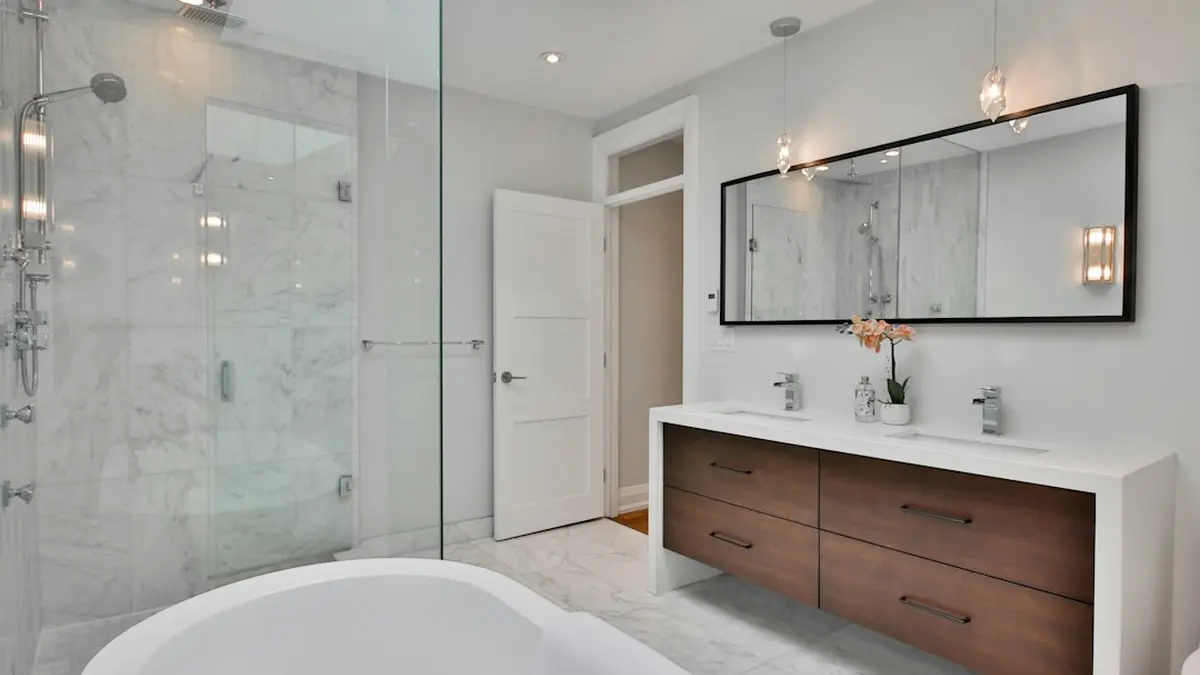
Replacing a bathroom exhaust fan with a similar model costs $150 to $550 installed, according to HomeGuide's 2026 cost guide. HomeAdvisor's guide (as read in September 2026) puts the average simple swap at $266. If there is no usable duct and the installer has to run a new one outside, HomeGuide's range rises to $250 to $950. If your old fan still exhausts to the outdoors and you buy a replacement close to its size, plan on the lower range.
This page is for a homeowner with a noisy, dead or undersized fan, or one planning a bathroom remodel where the fan is a single line on a longer bid. It separates the fan from the labor, shows what moves the total, and explains how to read a quote so you can tell which kind of job you are being charged for.
The most common mistake is holding a swap quote up against the wrong average. The figure you will see most often, Angi's 2026 national average of $396, comes from bathroom fan installations, and Angi presents those as costing more than like-for-like replacements. A $300 quote for a straight swap is not a bargain measured against $396. It is squarely in the replacement range.
Swap or new install: two different jobs
A bathroom fan job is one of two things, and the price depends on which one it is.
A like-for-like swap reuses what is already there: the ceiling opening, the duct and the wiring. The installer shuts off power, removes the old unit, prepares the opening, wires and mounts the new fan, connects it to the existing duct and confirms that it runs. That list is the scope Homewyse defines as "basic minimum labor to replace bathroom fan with favorable site conditions." HomeGuide says a replacement usually takes 2 to 3 hours of labor at $50 to $100 an hour, which works out to about $100 to $300 in labor before the fan.
A new installation adds work outside the bathroom. That can mean a new duct run, a hole through an exterior wall or the roof, and sometimes a new circuit. It applies when there was never a fan, when the old fan vented into the attic instead of outdoors, or when the new fan is a different size or mounting type. HomeAdvisor prices complex jobs involving new ducting at up to 4 hours of labor, or $160 to $400.
| Like-for-like swap | New installation | |
|---|---|---|
| Installed cost (HomeGuide, 2026) | $150 to $550 | $250 to $950 |
| Average and range (Fixr, as read Sept. 2026) | $200 average, $150 to $500 | $400 average, $250 to $900 |
| National estimate per fan (Homewyse, Sept. 2026) | $196 to $420 | $352 to $914 |
| Labor time and cost (HomeAdvisor, as read Sept. 2026) | Up to 2 hours, $80 to $200 | Up to 4 hours, $160 to $400 |
| Labor share (Fixr, as read Sept. 2026) | $150 to $250 | $250 to $500 |
| What gets reused | Opening, duct, wiring | Little or nothing; duct and vent are new, wiring may be |
| Wrong choice if | The old fan vents into the attic or is too small for the room | A working duct to the outside already exists and the new fan fits the old opening |
Most of the difference between these ranges comes from method, not from disagreement. Homewyse's installation estimate builds the price from line items and includes delivery, site protection and mobilization, so it lands higher than the others. Angi's $396 comes from 2,554 verified projects completed by Angi pros, and most homeowners in that sample paid $241 to $563. Angi attributes the spread to bathroom size, fan type and how complicated the duct and vent work is.
Pricing the job, step by step
Collect these before you call anyone. With them, you can tell an installer which job you need, and you can check a quote against the ranges above.
-
The bathroom's square footage
Multiply length by width. The number sets the fan size you need.
-
A photo of the old fan with the grille off
The housing and its label tell an installer the size, which determines whether a direct swap is possible.
-
Where the duct ends
Check whether it reaches a wall or roof cap outdoors or stops in the attic.
-
Whether there is attic access above the bathroom
Fixr ties the higher cost of ceiling fans to attic access and duct routing.
-
Which switch controls the fan, and whether a light shares it
Adding a light, heater or sensor can change the wiring.
-
Your finish tier
Budget, mid-range or high-end. See step 3.
1. Size the fan to the room. HomeAdvisor uses the standard rule of about 1 CFM (cubic feet per minute of airflow) per square foot of floor, with 50 CFM as the minimum. By that rule, a 40 sq. ft. hall bath needs 50 to 60 CFM, and HomeAdvisor lists fans in that size at $16 to $75. A 144 sq. ft. primary bath needs 150 to 250 CFM, at $100 to $300 for the fan. This step costs you ten minutes. When it is done you have a CFM number to write on every quote request.
2. Find out whether a swap is possible. A swap requires a working duct that reaches the outdoors and a replacement that fits the existing housing. HomeAdvisor's advice is direct: "look for a replacement that is as close to the same size and design as your existing unit." If the duct stops in the attic, or the fan you want needs a larger opening, you are pricing a new installation. The check costs nothing if you can reach the attic. You know it worked when you can say "swap" or "new install" to an installer without guessing.
3. Pick a tier. The fan is the smallest part of the bill and the easiest to control. The cost guides price the tiers like this:
- Budget: a basic exhaust-only fan. HomeGuide lists basic toilet exhaust fans at $20 to $50, and Fixr lists a basic unit at $50 to $75. This suits a powder room, a rental, or a hall bath where the old fan needs replacing and nothing else about the room is changing. It is the wrong choice for a primary bath where steam lingers or a fan that sits over the vanity light.
- Mid-range: a fan with a light, a humidity sensor, or both. Fixr puts a light at $50 to $100 more and a humidity sensor at $75 to $125. This suits most full-bath remodels, especially ones where family members forget to turn the fan on.
- High-end: HomeGuide lists Energy Star-rated fans with lights, motion sensors and humidity sensors at $200 to $400. Fixr lists Bluetooth fans at $150 to $200 and variable-speed fans at $75 to $400. HomeAdvisor prices add-ons such as humidity sensors, automatic timers and variable-speed controls at $150 to $300 each. This tier makes sense in a high-end primary bath. It is money wasted in a powder room that gets a few minutes of use a day.
The brief for this page asked for current listed prices on specific models. We did not verify retailer listings for any named fan while writing it, and we did not test any fans, so this page names no models and makes no claims about noise or airflow for any product. For those, use the maker's or retailer's listing on the day you buy: the CFM rating, the sone (loudness) rating and the price. The tier ranges above tell you whether that price is typical.
4. Request written bids that separate the lines. A readable fan quote shows the fan unit, the labor hours and the hourly rate, any duct or vent work, any wiring or circuit work, the permit if one is needed, and disposal. Homewyse's replacement estimate breaks the job into those same pieces: the fan unit, base labor and job supplies (connectors and fasteners) at $47.38 to $58.24 each, disposal at $1.42 to $1.61, and an optional AFCI circuit protection line at $47.38 to $58.24. A bid that shows one number with no breakdown gives you nothing to compare. Allow a few days to collect two or three bids.
5. Check each line against the ranges. For a swap, labor should be close to 2 to 3 hours at $50 to $100 an hour (HomeGuide, 2026). If a swap bid lists 4 hours, ask what the extra time covers. The answer is usually duct work, and that means the installer is not treating the job as a swap. HomeAdvisor prices duct replacement or installation at $95 to $500 in total ($45 to $400 in labor plus $50 to $100 in materials). HomeGuide prices venting through an exterior wall at $250 to $800.
6. Ask who pulls the permit, and whether one is needed. Neither of the Homewyse estimates includes permit fees, and none of our sources gives a permit price for this job, so we can't give you a figure. Requirements vary by jurisdiction. If new wiring or a new circuit is part of the job, ask the installer directly whether your town requires a permit, who files it, and whether the fee is in the bid.
7. Confirm the work once it is finished. Homewyse's scope ends with the installer verifying that the fan works. Do the same yourself. Turn the fan on and look for a response at the outdoor cap, or have the installer show you that the duct connects to it. A fan that runs but exhausts into the attic has not solved the problem you paid to fix.
Where fan quotes go wrong
Buying a fan that doesn't fit the old opening. HomeAdvisor's main cost warning is that a replacement close in size and design to the existing unit keeps the job simple. How to recognize it: you buy the fan first, and the installer's bid includes cutting or framing. What to do: measure the old housing, or hand it to the installer, before you choose the fan.
Treating a favorable-conditions estimate as a firm price. Homewyse says outright that its replacement figure assumes favorable site conditions. It excludes structural changes, surface finish repairs, code-compliance upgrades and hazardous material testing. How to recognize it: the bid is low and says nothing about the ceiling around the fan. What to do: ask what happens if the opening has to be enlarged or the drywall is damaged, and get that answer in writing.
Missing the markup. Homewyse notes that general contractor overhead adds 13% to 22% when a GC manages the job, and that sales tax is not in its figures. How to recognize it: the fan is part of a remodel bid and the price is well above the ranges on this page. What to do: this may be legitimate, but it should appear on the bid, so ask whether the fan line includes the GC's margin.
Choosing an inline fan for the wrong house. Fixr prices inline fans at $200 to $500 (average $300) but says they are practical only where they tie into an existing HVAC system. If you have no system of that kind, the low price doesn't apply to you.
Undersizing. A fan under the 1-CFM-per-square-foot guideline is cheaper to buy and does not clear the room. How to recognize it: the bid names a 50 CFM fan for a bathroom much larger than 50 sq. ft. What to do: go back to step 1 and ask for a fan rated at or above the room's square footage.
Cases that change the number
Where you live. This blog normally splits costs across the Northeast, South, Midwest and West. For bathroom fans, none of our sources publishes figures by region, so we can't give you those ranges. What the sources do say is that location matters. Homewyse says its pricing is highly sensitive to zip code, and Angi publishes local cost pages (Chicago is one example) that adjust its national figures for local labor rates. Use the national ranges on this page as a baseline and expect your local bids to fall higher or lower depending on labor costs where you live.
Ceiling or wall mount. Fixr prices ceiling-mounted fans at $400 to $900 installed, because the work involves the attic and a duct run. Wall-mounted fans run $300 to $500 because they need less duct. A bathroom on an exterior wall with no attic above it is often the simpler job.
A heater, light or smart features. HomeAdvisor lists fan-and-heater units at $155 to $640 installed, fan-light-heater combinations at $155 to $475 installed, and Bluetooth fans at $170 to $500 installed. Because a heater adds electrical load, find out whether the existing circuit can support it before you commit.
Old or questionable wiring. HomeGuide includes the condition of the existing wiring as a cost factor. Homewyse lists AFCI circuit protection as an optional line: $47.38 to $58.24 in its replacement estimate and $98.24 to $234.06 in its new-installation estimate (both September 2026). HomeAdvisor cites electrician rates of $40 to $100 an hour.
Several fans at once. Homewyse counts the number of units among its main price factors. If two bathrooms need new fans, getting both on one visit gives the installer a chance to spread setup time across two fans.
Siding. HomeGuide notes that the siding the installer has to cut through for a new wall vent affects the price.
Tariffs in 2026. A binding customs ruling, CBP NY N005898, classifies permanently installed bathroom ceiling ventilation fans under HTS 8414.51.3000 at a general duty rate of 4.7%. It covers combined fan-light units too, reasoning that "the fan … gives the goods their essential character." That rate is separate from, and adds to, any Section 301 duties on Chinese goods. A proclamation effective April 6, 2026 also restructured the metal tariffs on aluminum, steel and copper products. It exempts goods containing less than 15% of the covered metals by weight. Our sources don't say whether any particular fan falls under those metal duties, and none of the cost guides here shows a separate tariff effect on fan prices. Treat the tier ranges as current as of their dates, and check the listed price on the day you buy.
The figures at a glance
The fan itself costs $20 to $400 (HomeGuide, 2026), and HomeAdvisor gives an average of $145 for the unit. Labor makes up most of the bill on a simple job, and duct work makes up most of the bill on a complicated one. The largest jump on this page does not come from choosing a better fan. It is the step from a swap to a new installation, where Fixr's averages go from $200 to $400.
On the value side, our sources do not report a resale payback for a bathroom fan, so we won't give one. The case for spending on a fan rests on its function. It clears moisture from a room where a fan that is undersized, dead or venting into the attic doesn't.
Questions homeowners ask
Doing it yourself, or paying for two hours
A like-for-like swap is the job where doing it yourself saves the most, since labor is most of the cost. HomeGuide's 2 to 3 hours at $50 to $100 an hour means you save roughly $100 to $300 by doing it yourself. That math only works if the new fan fits the old housing, the duct already reaches the outdoors, the wiring is sound and you are comfortable working on a circuit with the power off.
Once the job involves the attic, a new wall or roof penetration, or new wiring, a pro becomes the better choice. That work is where HomeAdvisor's labor estimate doubles to up to 4 hours, where siding and duct routing add cost you can't see in advance, and where a permit may apply. It is also where mistakes cost the most to fix, because a duct that ends in the attic or a poorly sealed vent in the siding leaves you with the moisture problem you were trying to solve.
Every figure on this page is a planning number, dated and sourced. None of them is a quote. The price you pay depends on your ceiling, your duct run, your wiring and local labor rates, and only an installer who has seen the bathroom can price those. Take the CFM figure from step 1, the swap-or-install answer from step 2 and your tier, and get at least two itemized bids.
Comments
No comments yet. Be the first to comment!
Leave a Comment